Early Spanish Learning: The Neve Method™ Explained

Updated: 1 day ago
A Whole-Child Approach to Early Spanish Learning

The Neve Method™ is Neve Spanish Academy's research-informed approach to early childhood Spanish learning. It helps children build understanding and communication through meaningful experiences, cumulative learning, whole-child development, and everyday interaction.
The Method guides how we introduce, support, revisit, and use Spanish. Discovering My World in Spanish™ puts it into practice for children ages 1–6.
The goal is not to collect Spanish words. The goal is for children to understand Spanish, participate with it, learn through it, and increasingly use it to communicate.
Why the Neve Method Was Created
Families can find Spanish songs, apps, books, flashcards, and printables almost anywhere. The harder question is how those pieces work together to develop meaningful communication.
Exposure is an important beginning. It becomes more useful when Spanish is connected to something the child can see, do, feel, understand, or share with another person. The Neve Method provides that connection and gives important language a reason to return.
The Seven Pillars
Seven connected pillars put the Neve Method into practice. They are organized into four areas: Foundations, Learning Design, Progression, and Learning Environment.
Foundations
Whole-Child Development Domains
Spanish develops alongside the rest of childhood. Experiences consider speech, language, and communication; cognitive and executive function; social-emotional growth; movement; sensory regulation; literacy and reasoning; practical life; creativity; independence; and character. Spanish is the language being developed, but the whole child is learning.
Cumulative Learning and Core Threads
Important language does not disappear when a lesson ends. Words, sentence patterns, skills, and ideas return through stories, audio, play, missions, routines, and future lessons. Core Threads such as colors, numbers, shapes, weather, calendar language, and early sounds provide continuity across topics.
Learning Design
Communication Experiences
Children use Spanish for a purpose through ESCUCHA, HABLA, CREA, EXPLORA, CONECTA, TOCA, PIENSA, and MUÉVETE. Stories, conversation, movement, creative work, practical tasks, sensory exploration, and family experiences move learning beyond isolated vocabulary.
Screen-Free Learning
The child's learning foundation is hands-on and screen-free. Families print what they need and use Spanish through play, movement, books, conversation, exploration, and everyday routines. Parents use the online hub, native-speaker audio, and digital guidance to support the experience without turning it into a child-facing screen course.
Progression
Expanding World Progression
Learning expands through My First World, My Community, Our World, and Our Universe. Spanish begins with the child, family, needs, feelings, and routines, then grows toward community, nature, culture, geography, science, history, and larger ideas.
Explorer Journey
Explorers use words and short phrases. Adventurers use complete sentences and add details. Discoverers build expanded, connected language and deeper thinking. These are language supports, not age groups or digital progress levels. A six-year-old who is new to Spanish can begin as an Explorer, and families can choose the prompt that fits each moment. The website does not assign or track a child's level.
Learning Environment
Learning Ecosystem
Connected resources help Spanish continue beyond one activity. The Weekly Explorer Map, Pasaporte del Explorador, Misiones y Aventuras, Diccionario Ilustrado, Revista, etc., work together so families can revisit and use what children are learning.
What This Looks Like at Home
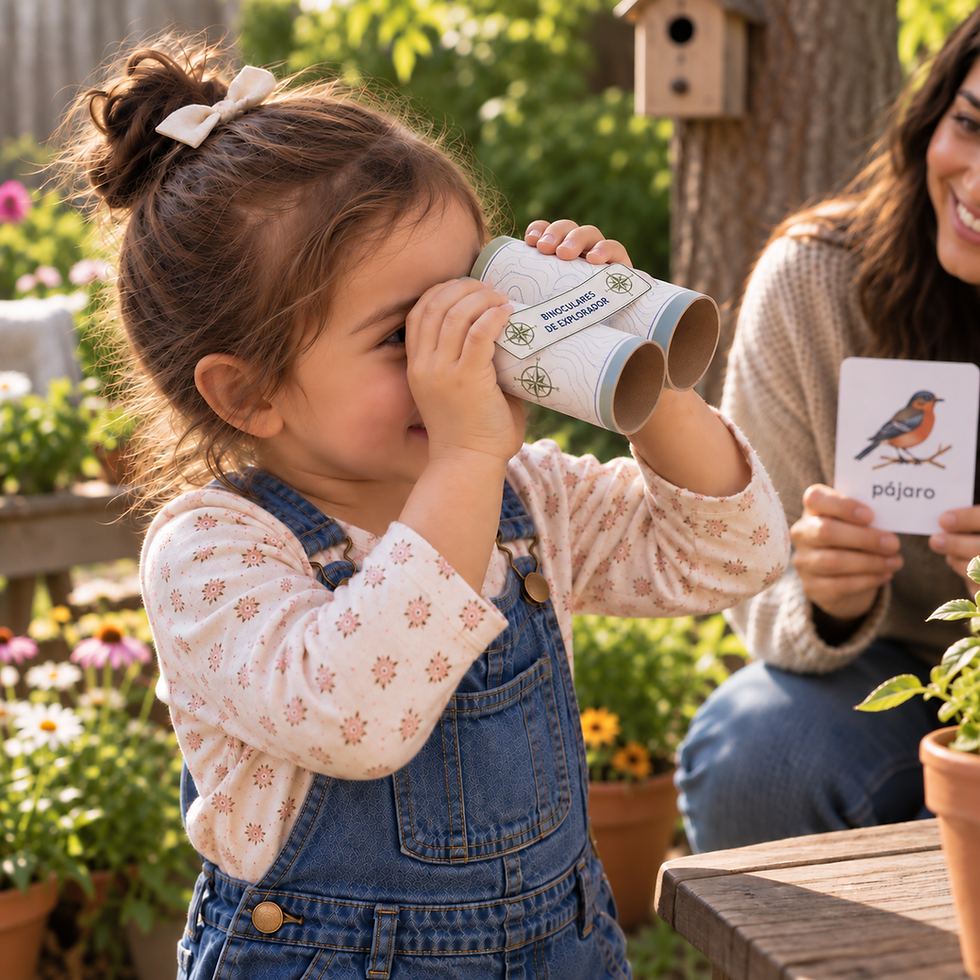
Imagine a child learning about a garden. The lesson may introduce flor, hoja, tierra, and agua, but it does not stop with naming pictures. The child might listen to a story, plant a seed, compare leaves, follow a direction, search for colors outside, or talk about what a plant needs.
The same language can return later while exploring weather, food, insects, seasons, or the environment. The experiences change, but the language stays connected. Familiar words gain new meaning and become easier to understand and use.
The N.E.V.E. Conversation Strategy
The N.E.V.E. Conversation Strategy™ is the parent communication tool used throughout the framework. Parents Notice what has the child's attention, Engage in the moment, Verbalize with useful Spanish, and Expect a Response by pausing and making room for participation. N.E.V.E. operates across the seven pillars; it is not an eighth pillar.
A Research-Informed Educational Approach
The Neve Method™ is informed by established principles from child language development, bilingual language acquisition, early childhood education, Montessori-inspired learning, play-based education, learning science, instructional design, responsive interaction, and family-centered practice.
Neve Spanish Academy organizes these principles into a connected approach for early Spanish education. The Method is educational and is not a clinical protocol, diagnostic tool, or speech-therapy service.
Continue Exploring
Starting with a baby? Read the free guide When Should I Start Raising a Bilingual Child? How to Introduce and Support Spanish from Birth to 12 Months.
Ready for a connected Spanish program for ages 1–6?

Comments