Spanish Language Development at Home | N.E.V.E. Conversation Strategy™

Updated: 1 day ago
A Practical Way to Build Spanish Through Everyday Interaction

You do not need to turn every part of your child's day into a Spanish lesson. Start by noticing the language opportunities already there.
Your baby reaches for the banana on your plate. Your toddler notices a dog outside. Your preschooler struggles with a zipper. Each moment already includes attention, curiosity, and a reason to communicate.
The N.E.V.E. Conversation Strategy™helps you know what to do next.
Developed by Neve Spanish Academy as part of the Neve Method™, N.E.V.E. organizes established responsive-interaction principles into four practical actions:
Notice → Engage → Verbalize → Expect a Response
Notice
Follow what has your child's attention.
Before deciding what to teach, notice what already matters to your child. A baby turns toward a barking dog. A toddler examines an ant. A preschooler keeps trying to close a zipper. Start there.
If your child opens and closes a box, abrir, cerrar, adentro, afuera, vacío, and lleno have an immediate context. Instead of beginning with “What word should I teach?” ask, “What is my child already experiencing?”
Engage
Join the moment instead of redirecting it.
Move closer. Point, help, imitate, react, or wonder together. If your child discovers a puddle, you might say, “¡Mira ese charco!” When your child steps in, add, “Estás pisando el agua. ¡Otra vez!” The experience gives the Spanish meaning.
Verbalize
Provide useful Spanish connected to the experience.
Verbalizing is more than labeling. Name what your child notices, then describe, connect, explain, or expand it.
Your child sees a butterfly: “Una mariposa.” It lands on a flower: “La mariposa está en la flor.” It flies away: “¡Está volando! ¡Se fue la mariposa!” The word mariposa becomes connected to movement, location, and a real event.
Children often understand more than they can say. The goal is not immediate memorization or perfect repetition. It is meaningful language that returns in useful contexts.
Expect a Response
Pause and make room for participation.
Expecting a response does not mean demanding one. It does not require your child to repeat a word, answer correctly, make eye contact, or demonstrate what they know.
A response may be a sound, word, phrase, gesture, movement, action, sign or AAC selection, drawing, point, choice, question, idea, or continued observation. Say something, pause, and notice how your child participates.
A Real-Life Example
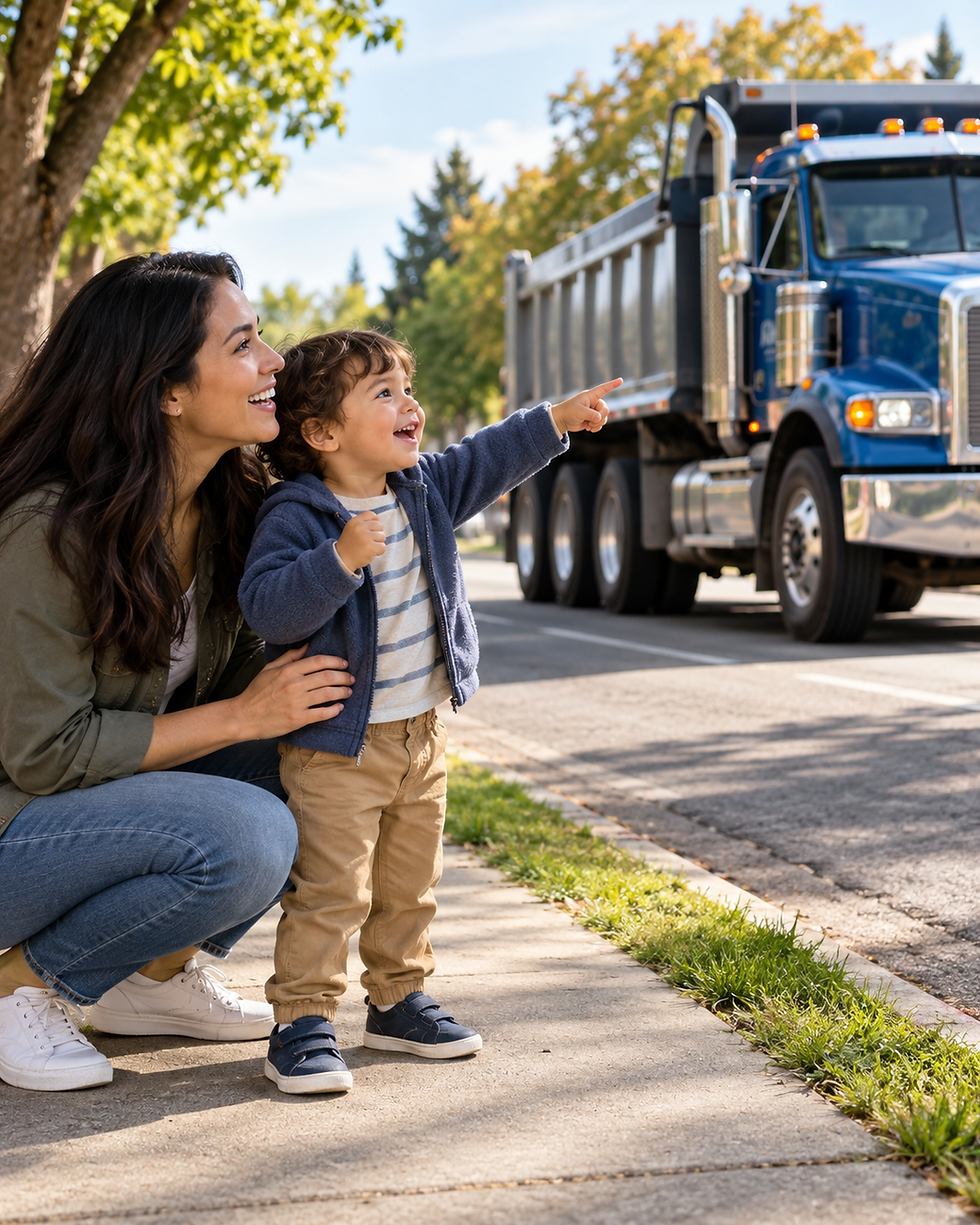
Your child points toward a truck.
Notice>¡Un camión!
Engage> Look toward it together. ¡Mira! Es un camión grande.
Verbalize> El camión va rápido. Está llevando muchas cosas.
Expect a Response> Pause. Your child makes an engine sound. You answer, ¡Sí! El camión hace mucho ruido.
Your child did not need to repeat camión on command. They heard Spanish connected to something meaningful and participated in the exchange.
When Your Child Responds in English
Keep the conversation going. If your child understands your Spanish but answers in English, the response still communicates an idea.
Your child says, “The dog is running!” You might answer, “¡Sí! El perro está corriendo. ¡Corre muy rápido!” You acknowledge the idea and provide the Spanish that matches it without turning the exchange into a test.
How N.E.V.E. Grows With the Child
Families can begin during infancy and continue adapting the strategy as communication develops. A baby may respond through attention, expression, sound, or movement. A toddler may point, act, choose, or use an emerging word. An older child may describe, explain, predict, solve a problem, or tell a story.
The four actions remain recognizable. The language and conversation expand with the child.
Frequently Asked Questions
Do I need to speak Spanish fluently?
No. N.E.V.E. describes how to approach communication. Use the Spanish you know and rely on accurate pronunciation, native-speaker audio, and parent guidance when needed. You can also do this only with your native language.
Should I make my child repeat Spanish words?
Not in every interaction. Repetition can be useful when it feels natural, but children can also listen, understand, gesture, choose, act, and communicate without performing each new word on demand.
Is N.E.V.E. the Same as the Neve Method™?
No. The Neve Method™ is the broader educational approach guiding Neve Spanish Academy. The N.E.V.E. Conversation Strategy™ is a parent communication tool used throughout Communication Experiences, stories, audio, play, routines, missions, and real-life interaction. It works across the seven pillars but is not an eighth pillar.
Continue Building Spanish
Starting with a baby? Read When Should I Start Raising a Bilingual Child? How to Introduce and Support Spanish from Birth to 12 Months.
For children ages 1–6, Discovering My World in Spanish™ puts the Neve Method into practice through connected, parent-guided, screen-free learning experiences.
Research and Further Reading
N.E.V.E. is an evidence-informed organization of established principles, not a claim that the underlying interaction principles are a new discovery. These resources are especially relevant to responsive interaction and bilingual language input.
Center on the Developing Child at Harvard University Serve and Return
Byers-Heinlein and Lew-Williams 2013 Bilingualism in the Early Years
Fibla and colleagues 2022 Bilingual Language Development in Infancy
Hoff and Core 2013 Input and Language Development in Bilingually Developing Children

Comments